Designing a connected employee development ecosystem

Enocta Talent Platform

Bringing performance, feedback and mentorship together into one coherent experience for employees, managers and HR teams.

From organizational goals to individual growth

A connected product ecosystem designed to help organizations define performance, understand development needs and support continuous employee growth.

Key Contributions

Product Strategy · Enterprise UX · Multi-role Product Design · Information Architecture · OKR & KPI Workflows · Feedback & Competency UX · Mentoring Journeys · Design System

Mentorship:

supporting mentors, mentees and HR teams from discovery and matching through sessions, shared goals and long-term progress.
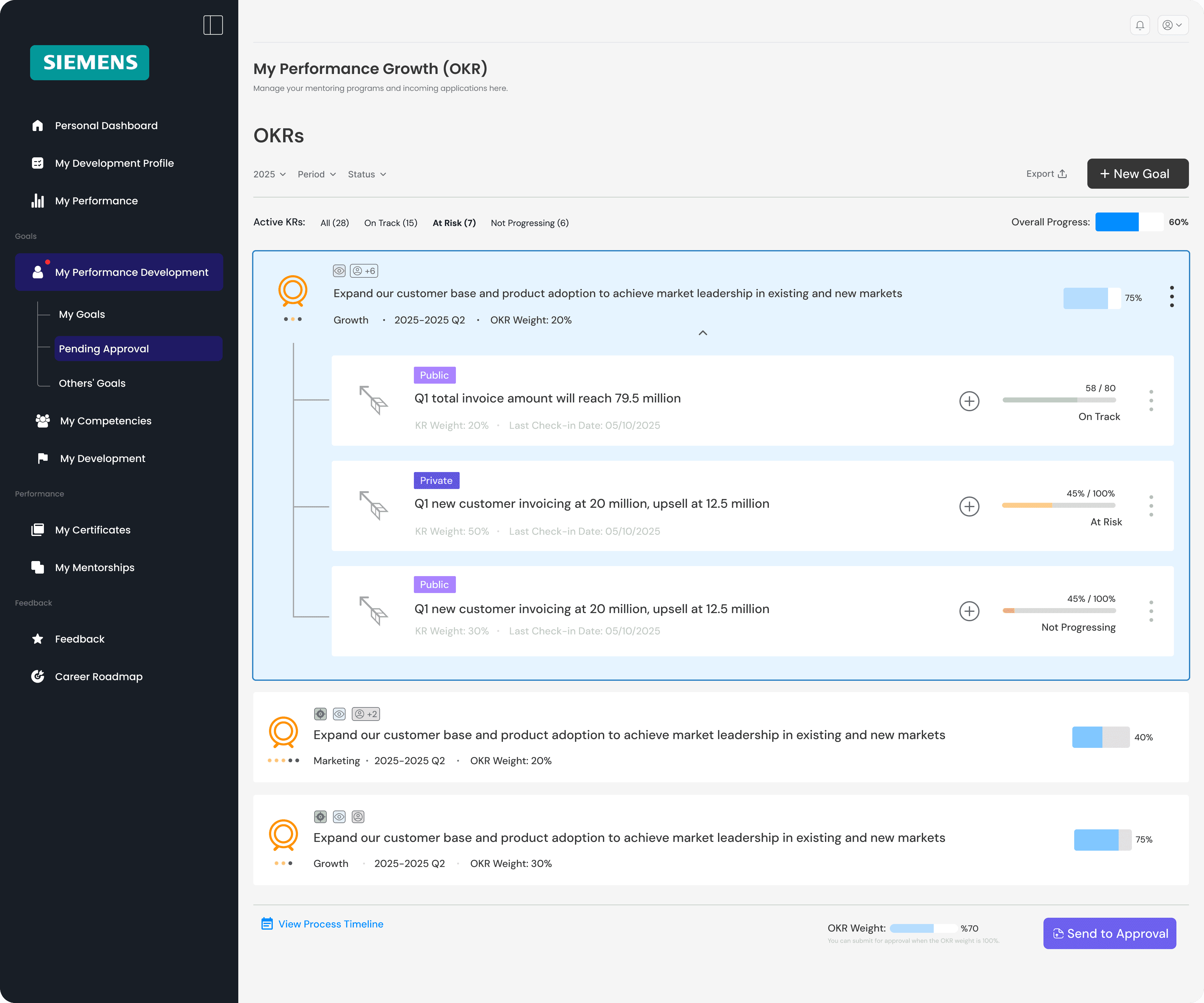
Goals & OKRs:

turning organizational goals into visible, trackable progress.

Feedback:

helping employees understand their strengths and development areas instead of isolated scores or complex competency data.

Impact

Key Objectives

Simplify complex enterprise workflows

Turn business requirements into intuitive product experiences

Design for multiple roles, permissions, and user needs

Create scalable patterns across interconnected products

3

connected products

connected products

connected products

Different moments of employee development were brought together within one coherent ecosystem.

Different moments of employee development were brought together within one coherent ecosystem.

1

shared system

shared system

shared system

Role-specific experiences were designed around shared information, workflows and organizational context.

Role-specific experiences were designed around shared information, workflows and organizational context.

From goals to growth

From goals to growth

From goals to growth

Performance defines where people are going, feedback reveals development needs and mentorship supports the journey forward.

Performance defines where people are going, feedback reveals development needs and mentorship supports the journey forward.

Reusable foundations

Reusable foundations

Reusable foundations

Shared interaction patterns and product principles created greater consistency while allowing each product to serve a distinct purpose.

Shared interaction patterns and product principles created greater consistency while allowing each product to serve a distinct purpose.

Enocta:

the Talent Intelligence Platform trusted by 550+ corporate customers.

Enocta:

the Talent Intelligence Platform trusted by 550+ corporate customers.

  • Explore full case story

Mentor View:

reviewing incoming mentee requests and accepting them in a single step.

The Problem

Employee development does not happen in separate systems


Employee development does not happen in separate systems

Performance management, feedback and mentoring are closely connected in practice.


Goals establish what employees are expected to achieve. Feedback helps them understand their strengths and development areas. Mentorship gives them support as they work toward those goals.


The challenge was not simply designing three HR products.

It was creating an ecosystem where each product could solve a distinct problem while still contributing to one continuous development journey.

Performance management, feedback and mentoring are closely connected in practice.


Goals establish what employees are expected to achieve. Feedback helps them understand their strengths and development areas. Mentorship gives them support as they work toward those goals.


The challenge was not simply designing three HR products.

It was creating an ecosystem where each product could solve a distinct problem while still contributing to one continuous development journey.


The core challenge

How might we connect performance, feedback and mentorship without turning employee development into a more complicated administrative process?
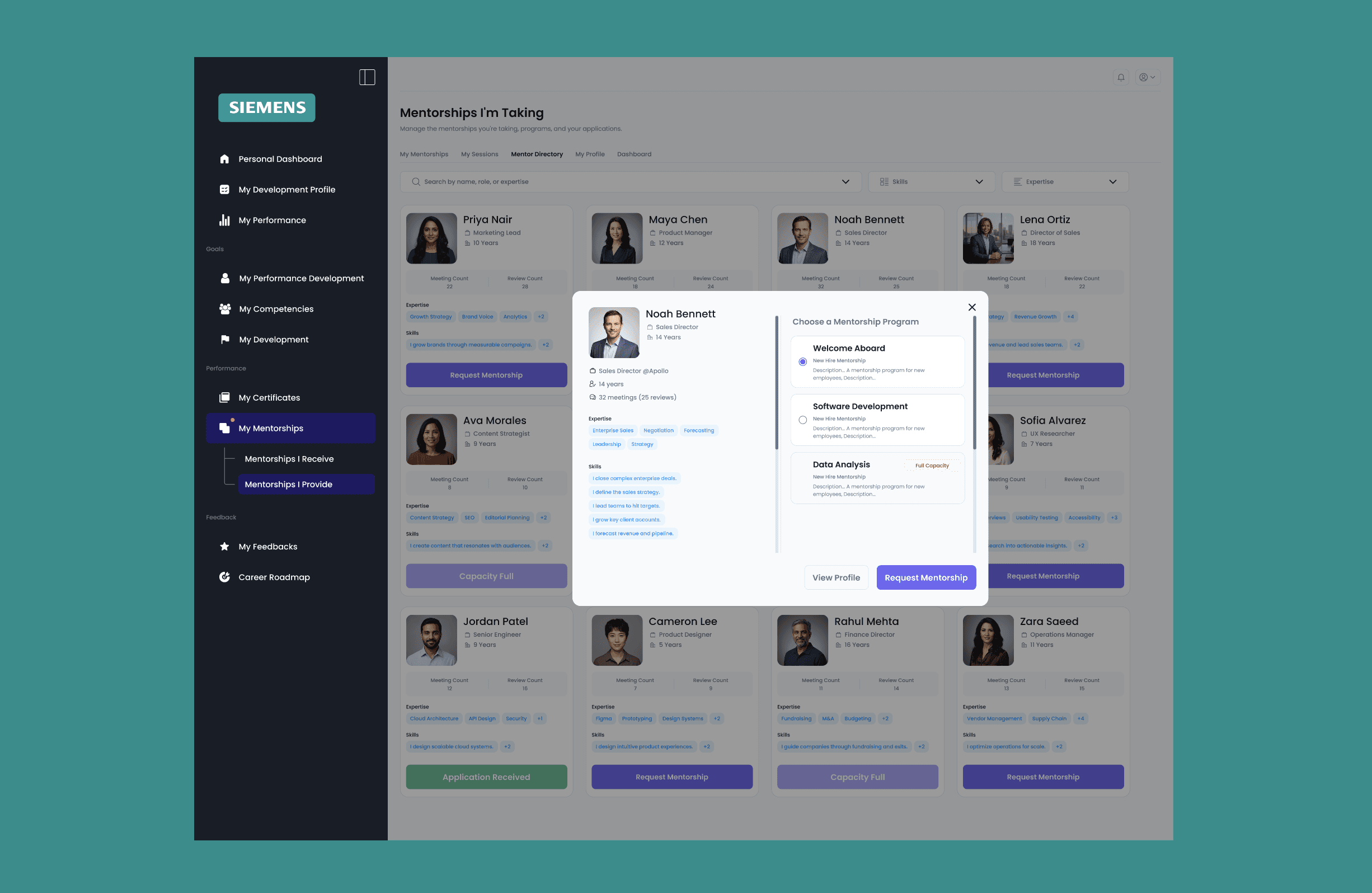
Mentor Directory:

mentees discovering mentors and requesting the right mentorship program.

Design Insights

Approach & Design

Every additional decision creates friction.

Every additional decision creates friction.

Employees need clear goals, feedback and next steps. Managers need additional context for approvals, evaluations and team development.HR teams need organizational visibility, configuration and program management capabilities. The experience needed to expose the right level of complexity to each role.

Employees need clear goals, feedback and next steps. Managers need additional context for approvals, evaluations and team development.HR teams need organizational visibility, configuration and program management capabilities. The experience needed to expose the right level of complexity to each role.

Employees need clear goals, feedback and next steps. Managers need additional context for approvals, evaluations and team development.HR teams need organizational visibility, configuration and program management capabilities. The experience needed to expose the right level of complexity to each role.

Performance, feedback and development reinforce one another

Performance goals become more valuable when employees understand which capabilities they need to develop. Feedback becomes more useful when it leads to action. Mentorship becomes more meaningful when it is connected to clear development goals. The products needed to feel related even when they supported different activities.

Performance goals become more valuable when employees understand which capabilities they need to develop. Feedback becomes more useful when it leads to action. Mentorship becomes more meaningful when it is connected to clear development goals. The products needed to feel related even when they supported different activities.

Structure should support people, not create bureaucracy

Enterprise HR processes require consistency and accountability, but excessive structure can make development feel administrative. The product needed to provide guidance without taking ownership away from employees, managers and mentors.

Enterprise HR processes require consistency and accountability, but excessive structure can make development feel administrative. The product needed to provide guidance without taking ownership away from employees, managers and mentors.

Organizational visibility needs clear boundaries

HR teams need enough information to operate performance cycles and mentoring programs. However, visibility should not mean exposing every interaction or removing the privacy required by feedback and mentoring relationships.

HR teams need enough information to operate performance cycles and mentoring programs. However, visibility should not mean exposing every interaction or removing the privacy required by feedback and mentoring relationships.

Design Roadmap Path

Design around the development lifecycle, not individual tools

Create role-based clarity

Prioritize information and actions differently for employees, managers, mentors, mentees and HR teams.

Connect insight with action

Ensure that performance and feedback do not end with a score, evaluation or completed workflow.

Maintain distinct product purposes

Performance, Feedback and Mentorship should feel connected without becoming one oversized product.

Make relationships visible

Show how individual goals connect to organizational objectives and how development activities support progress.

Success Criteria

Clarity

Can every user understand their responsibilities and next actions?

Continuity

Do goals, feedback and development feel like parts of the same journey?

Visibility

Can employees, managers and HR teams access the information appropriate to their roles?

Actionability

Does each product help users move from information to meaningful action?

Scalability

Can the system support evolving organizational structures and HR workflows without fragmenting the experience?

Final Experience
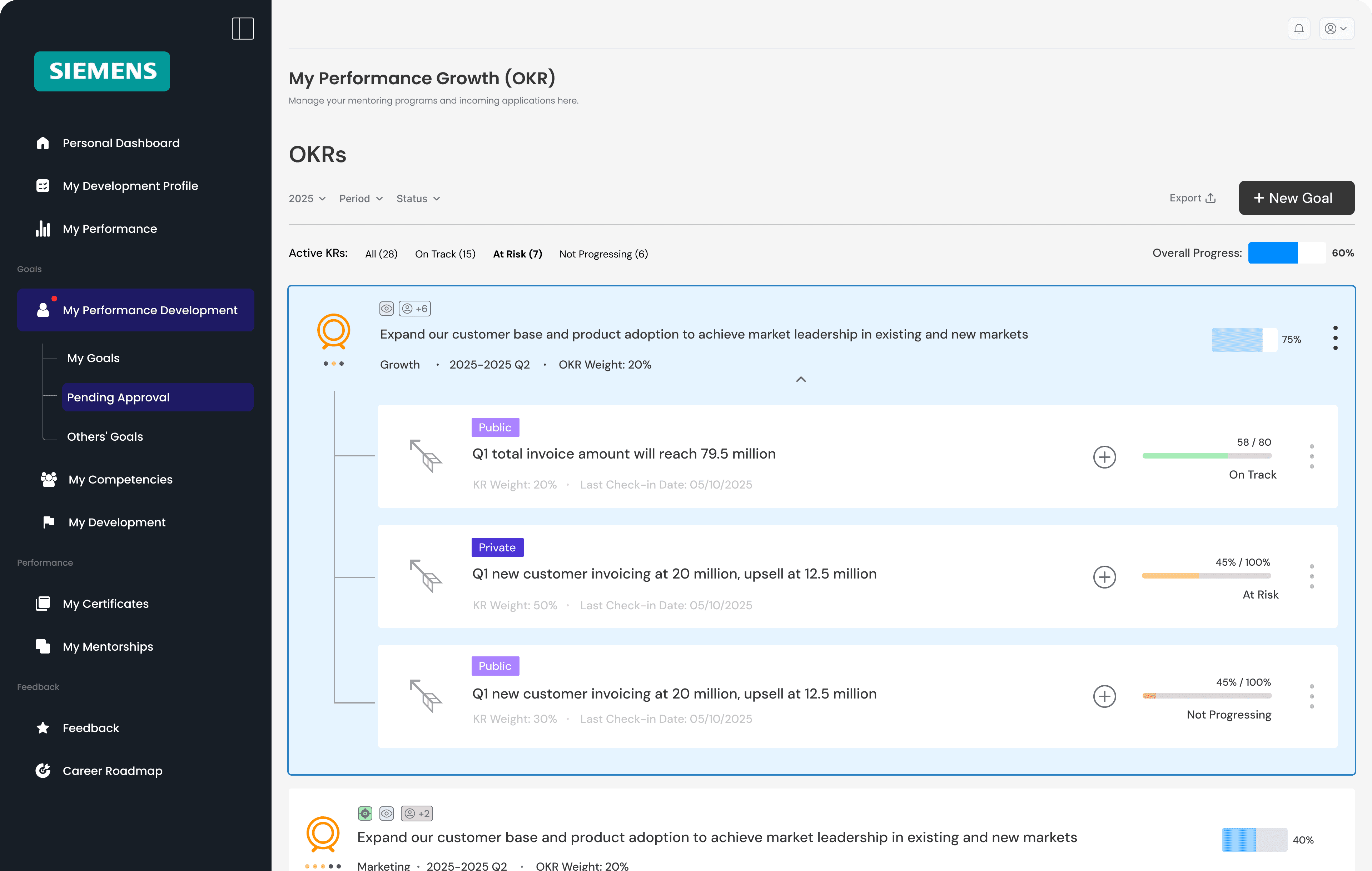
01. Performance: From organizational goals to everyday progress

Employees can create and follow structured goals while understanding how their work contributes to broader organizational objectives.Managers can review goals, track progress and support their teams with the context needed to make informed decisions.HR teams can manage performance cycles and maintain visibility across the organization.

02. Feedback: From evaluation to development

Feedback experiences help employees interpret competency data, recognize strengths and identify areas for growth. Instead of presenting evaluation as an isolated score, the product organizes results into a clearer development narrative.

03. Mentorship: From matching to meaningful development

Mentorship supports the relationship beyond the initial connection. Mentees can discover relevant mentors and establish development goals. Mentors can understand expectations and manage upcoming sessions. HR teams can operate programs without interfering with private mentoring relationships.

Key Learnings

Enterprise UX is also permission and responsibility design

Understanding who can see, decide, approve and act is as important as designing the interface itself.

Connected products need shared principles, not identical experiences

Consistency should help users move between products without removing the differences that make each product useful.

Information only creates value when it leads to action

Goals, scores and competency data become meaningful when users understand what they can do next.