Improving the path from healthcare discovery to treatment
Cue Health
Redesigning Cue Health’s digital commerce experience to reduce friction across complex healthcare journeys, improve product discovery, and turn more visitors into patients.

Improving the path from healthcare discovery to treatment
Cue’s digital experience needed to help customers navigate unfamiliar healthcare products while building enough confidence to make a purchase. Using behavioral data, experimentation and iterative design, I worked across discovery, navigation and product selection to reduce friction and improve engagement.
Key Contributions
Product Design · E-commerce UX · Experimentation · Behavioral Analytics · Prototyping · Design System
Product Page:
choosing a cartridge pack, quantity and Cue Reader in one clear flow.
Product Discovery:
browsing popular treatments with clear entry points to get started.
At-home Testing:
wellness panels that bring lab-grade testing into the home.

Health Intake:
a short questionnaire that personalizes the treatment path.

Eligibility:
simple, discreet questions to check whether a treatment is a fit.

Account Creation:
confirming eligibility and moving straight into sign-up.
Impact
Key Objectives
Simplify complex healthcare purchase journeys
Help users find the right treatment with confidence
Reduce friction from product discovery to conversion
Create a scalable experience across healthcare products
−17%
+26%
+32%
Explore full case story

The Problem
The core challenge
How might we reduce the cognitive load of choosing a health product without oversimplifying the information customers need to make a confident decision?
Research & Insights
Understanding where users were losing confidence
I combined behavioral data, heatmaps, funnel analysis, and usability insights to understand where users hesitated or abandoned the experience.
Three recurring issues emerged:
Discovery was difficult
Users struggled to understand Cue’s growing range of products and treatments.
Product pages carried too much responsibility
Users had to process significant information before knowing whether a treatment was relevant to them.
Healthcare decisions required more guidance
Unlike traditional e-commerce, users needed reassurance and context before committing to the next step.
These findings shifted the design question from:
“How do we improve the PDP?”
“How do we help users confidently identify and start the right care journey?”
01. A checkout questionnaire that felt like a detour
Users expressed dissatisfaction with the post-checkout questionnaire. Asking eligibility questions after the purchase decision created a disconnect in the journey.
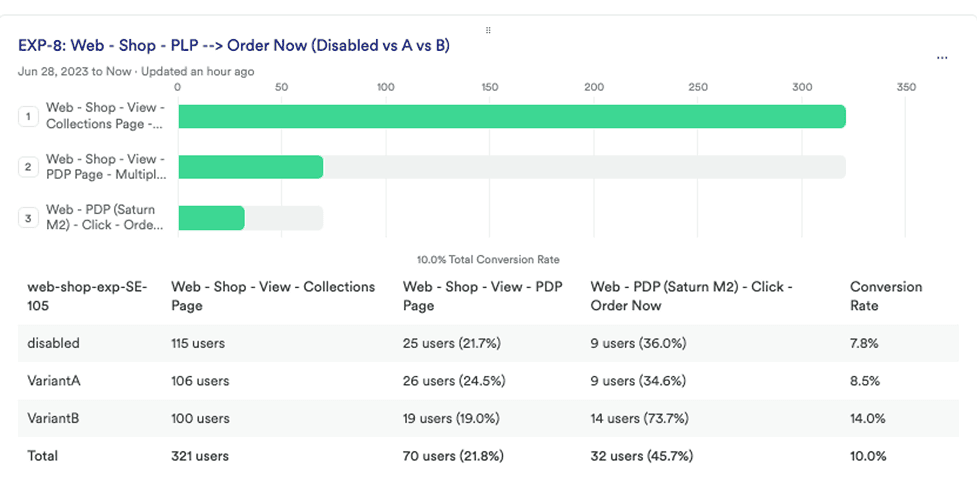
02. Engagement tools moved users forward
In EXP-8, engagement tools noticeably improved progression from the product details page to the “Order Now” CTA. Variant B reached a 14% conversion rate, compared to 7.8% for the control.

03. High interest, high attrition
At-home tests attracted strong click rates, yet 70% of users dropped off at the following step. The experience needed to be more compelling and easier to follow.

04. Users wanted to know more
85.71% of users showed interest in seeking additional information, highlighting the need for accessible, engaging content before a purchase decision.

05. Selection components caused drop-off
75% of users dropped off after interacting with the dosage and plan selection component, making it a critical area for design refinement.
Review: two paths to an Rx purchase
Option 1 streamlined checkout and let users select a dosage quickly, but risked disagreements with doctors and weaker engagement with eligibility questions. Option 2 asked eligibility questions before checkout, bringing transparency and confidence upfront. Its AI concierge drove higher conversion but also higher drop-off, revealing an opportunity to streamline the conversation and maximize conversions.
Navigation & Information Architecture
Product Discovery
Questionnaire-first journeys
PDP optimization

Treatment Finder:
a category-led entry point that helps visitors find the right treatment faster.
Connecting user needs, business goals, and healthcare constraints
As Senior Product Designer,
I worked across the end-to-end experience from problem definition through research, interaction design, prototyping, experimentation, and implementation.
I collaborated closely with product, engineering, growth, marketing, and healthcare stakeholders to balance:
User comprehension · Conversion · Business goals · Technical feasibility · Regulatory constraints
The work extended beyond individual features into the underlying UX and UI system used across Cue’s digital products.
Constraints & Decisions
Conversion could not come at the expense of trust
Healthcare commerce introduced constraints that conventional e-commerce patterns could not always solve.
Information needed to remain medically and legally appropriate while still being understandable.
The resulting design strategy focused on reducing unnecessary friction while preserving necessary friction.
Final Experience

A clearer way to navigate Cue
Helping customers understand the ecosystem before asking them to buy
Navigation was restructured to improve product discovery and create clearer paths into Cue's offering.

Starting with the customer, not the product
A questionnaire-first approach to product discovery
Instead of asking customers to navigate the catalog themselves, we explored an experience that started with their needs and progressively guided them toward a relevant product.

Designing consistency at scale
A system behind the experience
Alongside individual journeys, reusable patterns and components helped create greater consistency across Cue's digital commerce experience and made future iteration easier.
Key Learnings
In healthcare, clarity is part of the product
The project reinforced that optimizing healthcare experiences is not simply about removing steps.
Some friction exists because users need information, reassurance, or qualification before progressing.
That principle became central to how I approached Cue’s broader commerce and treatment experiences.